EVD educational toolkit
University Of Washington

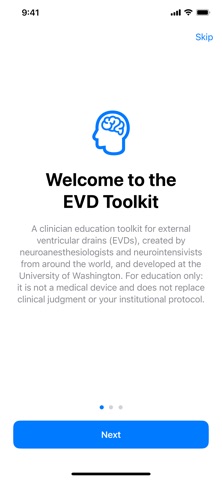
EVD educational toolkit is a clinician-facing reference on external ventricular drains (EVDs) and intracranial pressure (ICP) monitoring, designed for neuro-ICU and neuroanesthesia teams, nurses, and trainees. WHAT'S INSIDE • What is an EVD? Definition, common indications, and epidemiology • EVD Setup: leveling at the external auditory meatus, transducer safety, and drainage settings used in practice • ICP Waveforms: normal and abnormal P1/P2/P3 morphology with real bedside tracings • CT Imaging: expected catheter position and imaging examples • Transport & MRI Safety: a pre-transport checklist and MRI safety steps • Best Practices: do's and don'ts and CSF color interpretation • Clinical Pearls: concise, referenced teaching points • Types of EVD and EVD Systems: a photo library of devices and drainage systems • QI Metrics and EHR Alerts: suggested quality metrics, reportable events, and an example institutional EHR workflow • Educational videos, downloadable resources, and materials from the SNACC EVD Safety Campaign REFERENCED CONTENT Clinical content in the app is linked to published sources, including the SNACC perioperative guidelines for external ventricular and lumbar drains and the Neurocritical Care Society EVD consensus statement, with direct links to PubMed. Where content reflects one institution's practice rather than published evidence, the app says so. EDUCATIONAL USE ONLY This app is an educational resource. It is not a medical device, does not diagnose or recommend treatment for individual patients, and does not replace clinical judgment, institutional protocols, or manufacturer instructions. The app has no accounts and does not collect patient information. RESEARCH STUDY This app is part of a research study evaluating clinical implementation of the EVD Toolkit. The University of Washington Human Subjects Division reviewed the study and determined it exempt from further IRB review (STUDY00026573, approved 9/16/2026). Participation in the optional feedback survey is voluntary. Developed at the University of Washington.
Screenshots