有機化学の構造式
Hideki Touhara

For organic chemistry, first memorize all the structural formulas. Once you overcome that, studying organic chemistry will become much easier.
This resource covers essential chemical substances, including chemical formulas, structural formulas, and diagrams, to cover everything from daily study to the Common Test (Center Test) and difficult university entrance exams.
It also covers more challenging entrance exam questions.
Ask students to draw the structural formula of salicylic acid showing intramolecular hydrogen bonding (Osaka University)
Ask students to draw the structural formula of a carboxylic acid dimer due to intermolecular hydrogen bonding (Many universities ask this question)
Ask students to draw the structural formulas of lactic acid and malic acid and indicate the chiral carbon atom (Nagoya University)
Ask students to draw the structural formulas of maltose and triacetylcellulose (Kyoto University)
Ask students to draw the structural formulas of various sugars such as β-galactose and sucrose (Many universities, including Kyoto University)
Ask students to draw the structural formula of the ketone group (hydroxyketone group) of fructose in equilibrium (Kyushu University, Waseda University)
Ask students to draw the structural formula of ribose (Nagoya University)
Ask students to draw the structural formula of deoxyribose (Osaka University)
Ask students to answer "zwitterion" with α-amino acids (Kyoto University)
Ask students to draw the structural formulas of α-amino acids glycine, alanine, and asparagine (Kyoto University)
α-A Structural formula of serine in amino acids (Nagoya University)
Asking students to name sulfur-based functional groups such as "disulfide bond" and "mercapto group (thiol group)" (Kyoto University, Tokyo Medical and Dental University, Waseda University, etc.)
Asking students to write structural formulas of other base pairs following the example of the cytosine-guanine base pair (Osaka University)
Asking students to write the structural formula of the base pair formed by adenine in DNA (adenine-thymine base pair), clearly indicating the two hydrogen bonds (Waseda University)
Asking students to write structural formulas comparing natural rubber and gutta-percha (Osaka University)
The question, "Show the structural formulas of natural rubber and gutta-percha in a way that shows the difference in geometric isomerism (grouped by degree of polymerization n)" (Osaka University, first semester), caused a difference in difficulty because it was not included in some textbooks.
■Extracted Data (Researched while solving entrance exam questions)
University of Tokyo: 30 years' worth
Kyoto University: 25 years' worth
Tokyo Institute of Technology: Over 20 years' worth
Osaka University: 20 years' worth
Nagoya University: 10 years' worth
Waseda and Keio Universities: 7 years' worth of science and engineering faculties
Approximately 20 sets of entrance exam questions for national medical universities
2 years' worth of national chemistry entrance exam questions (approximately 100 sets)
Center Test/Common Test: 1990-2022 (all main and supplementary exams)
Chemistry and Basic Chemistry textbooks (Keirinkan, Sugaku Kenkyusha) (for reference only to align with the current curriculum)
I checked these and selected the necessary knowledge. It fully covers the current curriculum (2022).
(I plan to add experimental equipment and diagrams to further improve its completeness.)
*Adding data for 2020, 2021, and 2022 is currently underway.
The questions are arranged to aid memorization.
The questions also include hints to help you arrive at the correct answer and hints to help you remember important items.
○Main Usage
Basically, you learn by solving the problems.
■Review Test
Swipe left or right to display the next or previous question. Select the correct answer from the options, and tap the option to proceed to the next question. You can also swipe to proceed even if you don't get the answer right. In Normal mode, we've made it manual rather than timed so that you can proceed at your own pace and memorize at your own pace. An answer sheet is displayed at the end of the test.
■15-Question Test
This is a mini-test categorized by subject. It is intended to help you memorize a narrow range of topics, so it does not cover the entire range.
You have 10 seconds to solve each question, and then you check your answers at the end. You select one answer per question, and whether you answered correctly or incorrectly is displayed at the end of all 15 questions, or if you stop midway using the end button. Your performance is scored, and the progress of your score is displayed in a graph for visual reference. Test 15 focuses on a narrower range of topics, allowing you to achieve a high score relatively quickly through dedicated study. The question intervals and order incorporate a mechanism similar to the forgetting curve.
■ List
You can view a list of test topics categorized by subject.
■ Score
You can view your score report for Test 15 and the diagnostic test, categorized by subject.
■ Comprehensive Diagnostic Test (Challenge Test 25)
This test follows the same format as Test 15. By solving 25 questions from the entire range, you can assess how well you remember the structural formulas and chemical formulas of organic chemistry within the entrance exam scope. This test is also solved in the same way as Test 15. Your score is calculated, and you can visually track your score progression in a graph. Since the entire range is extensive, aim for a high score by combining category-based tests, review lists, and your personal list to reinforce your weaknesses. The question intervals and order incorporate a mechanism similar to the forgetting curve.
■ Review List
Incorrectly answered questions are automatically added to the list. Correct answers in the tests within the list remove the questions from the list. You can also manually select and delete items. You can also reset the list to zero using the "Reset Review List" button in the settings screen.
■ My List
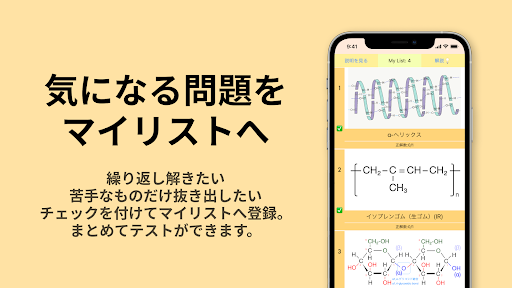
You can add items to your My List from any screen after the test results by selecting them with the Check button. By listing the things you want to remember and focusing on them, you can customize your weak point reinforcement. To remove items from the list, select them using the Edit button (bottom right). You can also reset the list to zero using the "Reset My List" button in the settings screen.
■ Score History
This is the score report for the 25-question diagnostic test. You can view the history of the last 100 tests and the Top 100.
■ Settings
・Ascending or Shuffle
You can choose between presenting questions in ascending order or shuffled.
Test 15 and the diagnostic test only use shuffled questions.
・You can choose the number of questions from 5, 10, 20, or all.
Test 15 and the diagnostic test have fixed question counts of 15, 20, and 25, respectively.
* Displaying Choices
Selecting "reveal" removes the cover. Selecting "hide" adds a cover, making the choices not immediately visible.
In Test 15 and the diagnostic test, the choices are always displayed.
* Continue or Start from the Beginning
The "continue" button allows you to resume from where you left off. The "reset" button returns you to the beginning.
* Normal, Blue, Pink, Green are buttons to change the background and text color.
The range of uses expands as you use the app more.
There are 5 patterns for each of the 4 color schemes. You can switch between 5 levels by pressing the benzene ring icon in the upper right corner of the Home screen or settings screen.
* Japanese - English
You can switch between English and Japanese, which is also useful for learning English vocabulary.
*You can select your desired language in this app, between English and Japanese.
*Reset Review List, Reset My List
Pressing this button will reset all items in the list to zero.
*Developer's Twitter
We'll be sharing tips for memorizing structural formulas, updates, and special offers on new apps. Please follow us!
■ Home
・Contents (Structural Formulas in Organic Chemistry) Japanese
Functional Groups and Groups
Hydrocarbons
Alcohols, Ethers, Ketones
Carboxylic Acids, Esters, Fats and Oils
Aromatic Compounds
Sugars
Amino Acids, Nucleic Acids
Resin, Rubber
・Contents (Structural Formula: Organic Chemistry) English
Functional Group
Hydrocarbon
Alcohol, Ether, Ketone
Carboxylic Acid, Ester, Fats and Oils
Aromatic Compound
Saccharide, Sugars
Amino Acid, Nucleic Acid
Resin, Rubber (Gum)
We also review the latest entrance exam questions and add any new information that may be needed.
If you have any requests for new features or questions, please leave a comment on Twitter, the blog, or in the reviews.
Developer Twitter
https://twitter.com/kagaku_y_test
Developer Blog
http://kojimachi.hatenablog.com
The illustrations (images) are drawn by Mumemomo.
Twitter
https://twitter.com/srnmomo
Pixiv
https://www.pixiv.net/member.php?id=6353852
Sound effects are used with permission from "Free Sound Effects Material Kurage Kosho".
http://www.kurage-kosho.info
Other
This app does not require permission for use in educational institutions such as schools and cram schools, or for instructional and learning activities by individuals. Similarly, it does not require permission for use on social media, video sites, or live broadcasts. If you wish to contact me, please do so via email or blog comments.
This resource covers essential chemical substances, including chemical formulas, structural formulas, and diagrams, to cover everything from daily study to the Common Test (Center Test) and difficult university entrance exams.
It also covers more challenging entrance exam questions.
Ask students to draw the structural formula of salicylic acid showing intramolecular hydrogen bonding (Osaka University)
Ask students to draw the structural formula of a carboxylic acid dimer due to intermolecular hydrogen bonding (Many universities ask this question)
Ask students to draw the structural formulas of lactic acid and malic acid and indicate the chiral carbon atom (Nagoya University)
Ask students to draw the structural formulas of maltose and triacetylcellulose (Kyoto University)
Ask students to draw the structural formulas of various sugars such as β-galactose and sucrose (Many universities, including Kyoto University)
Ask students to draw the structural formula of the ketone group (hydroxyketone group) of fructose in equilibrium (Kyushu University, Waseda University)
Ask students to draw the structural formula of ribose (Nagoya University)
Ask students to draw the structural formula of deoxyribose (Osaka University)
Ask students to answer "zwitterion" with α-amino acids (Kyoto University)
Ask students to draw the structural formulas of α-amino acids glycine, alanine, and asparagine (Kyoto University)
α-A Structural formula of serine in amino acids (Nagoya University)
Asking students to name sulfur-based functional groups such as "disulfide bond" and "mercapto group (thiol group)" (Kyoto University, Tokyo Medical and Dental University, Waseda University, etc.)
Asking students to write structural formulas of other base pairs following the example of the cytosine-guanine base pair (Osaka University)
Asking students to write the structural formula of the base pair formed by adenine in DNA (adenine-thymine base pair), clearly indicating the two hydrogen bonds (Waseda University)
Asking students to write structural formulas comparing natural rubber and gutta-percha (Osaka University)
The question, "Show the structural formulas of natural rubber and gutta-percha in a way that shows the difference in geometric isomerism (grouped by degree of polymerization n)" (Osaka University, first semester), caused a difference in difficulty because it was not included in some textbooks.
■Extracted Data (Researched while solving entrance exam questions)
University of Tokyo: 30 years' worth
Kyoto University: 25 years' worth
Tokyo Institute of Technology: Over 20 years' worth
Osaka University: 20 years' worth
Nagoya University: 10 years' worth
Waseda and Keio Universities: 7 years' worth of science and engineering faculties
Approximately 20 sets of entrance exam questions for national medical universities
2 years' worth of national chemistry entrance exam questions (approximately 100 sets)
Center Test/Common Test: 1990-2022 (all main and supplementary exams)
Chemistry and Basic Chemistry textbooks (Keirinkan, Sugaku Kenkyusha) (for reference only to align with the current curriculum)
I checked these and selected the necessary knowledge. It fully covers the current curriculum (2022).
(I plan to add experimental equipment and diagrams to further improve its completeness.)
*Adding data for 2020, 2021, and 2022 is currently underway.
The questions are arranged to aid memorization.
The questions also include hints to help you arrive at the correct answer and hints to help you remember important items.
○Main Usage
Basically, you learn by solving the problems.
■Review Test
Swipe left or right to display the next or previous question. Select the correct answer from the options, and tap the option to proceed to the next question. You can also swipe to proceed even if you don't get the answer right. In Normal mode, we've made it manual rather than timed so that you can proceed at your own pace and memorize at your own pace. An answer sheet is displayed at the end of the test.
■15-Question Test
This is a mini-test categorized by subject. It is intended to help you memorize a narrow range of topics, so it does not cover the entire range.
You have 10 seconds to solve each question, and then you check your answers at the end. You select one answer per question, and whether you answered correctly or incorrectly is displayed at the end of all 15 questions, or if you stop midway using the end button. Your performance is scored, and the progress of your score is displayed in a graph for visual reference. Test 15 focuses on a narrower range of topics, allowing you to achieve a high score relatively quickly through dedicated study. The question intervals and order incorporate a mechanism similar to the forgetting curve.
■ List
You can view a list of test topics categorized by subject.
■ Score
You can view your score report for Test 15 and the diagnostic test, categorized by subject.
■ Comprehensive Diagnostic Test (Challenge Test 25)
This test follows the same format as Test 15. By solving 25 questions from the entire range, you can assess how well you remember the structural formulas and chemical formulas of organic chemistry within the entrance exam scope. This test is also solved in the same way as Test 15. Your score is calculated, and you can visually track your score progression in a graph. Since the entire range is extensive, aim for a high score by combining category-based tests, review lists, and your personal list to reinforce your weaknesses. The question intervals and order incorporate a mechanism similar to the forgetting curve.
■ Review List
Incorrectly answered questions are automatically added to the list. Correct answers in the tests within the list remove the questions from the list. You can also manually select and delete items. You can also reset the list to zero using the "Reset Review List" button in the settings screen.
■ My List
You can add items to your My List from any screen after the test results by selecting them with the Check button. By listing the things you want to remember and focusing on them, you can customize your weak point reinforcement. To remove items from the list, select them using the Edit button (bottom right). You can also reset the list to zero using the "Reset My List" button in the settings screen.
■ Score History
This is the score report for the 25-question diagnostic test. You can view the history of the last 100 tests and the Top 100.
■ Settings
・Ascending or Shuffle
You can choose between presenting questions in ascending order or shuffled.
Test 15 and the diagnostic test only use shuffled questions.
・You can choose the number of questions from 5, 10, 20, or all.
Test 15 and the diagnostic test have fixed question counts of 15, 20, and 25, respectively.
* Displaying Choices
Selecting "reveal" removes the cover. Selecting "hide" adds a cover, making the choices not immediately visible.
In Test 15 and the diagnostic test, the choices are always displayed.
* Continue or Start from the Beginning
The "continue" button allows you to resume from where you left off. The "reset" button returns you to the beginning.
* Normal, Blue, Pink, Green are buttons to change the background and text color.
The range of uses expands as you use the app more.
There are 5 patterns for each of the 4 color schemes. You can switch between 5 levels by pressing the benzene ring icon in the upper right corner of the Home screen or settings screen.
* Japanese - English
You can switch between English and Japanese, which is also useful for learning English vocabulary.
*You can select your desired language in this app, between English and Japanese.
*Reset Review List, Reset My List
Pressing this button will reset all items in the list to zero.
*Developer's Twitter
We'll be sharing tips for memorizing structural formulas, updates, and special offers on new apps. Please follow us!
■ Home
・Contents (Structural Formulas in Organic Chemistry) Japanese
Functional Groups and Groups
Hydrocarbons
Alcohols, Ethers, Ketones
Carboxylic Acids, Esters, Fats and Oils
Aromatic Compounds
Sugars
Amino Acids, Nucleic Acids
Resin, Rubber
・Contents (Structural Formula: Organic Chemistry) English
Functional Group
Hydrocarbon
Alcohol, Ether, Ketone
Carboxylic Acid, Ester, Fats and Oils
Aromatic Compound
Saccharide, Sugars
Amino Acid, Nucleic Acid
Resin, Rubber (Gum)
We also review the latest entrance exam questions and add any new information that may be needed.
If you have any requests for new features or questions, please leave a comment on Twitter, the blog, or in the reviews.
Developer Twitter
https://twitter.com/kagaku_y_test
Developer Blog
http://kojimachi.hatenablog.com
The illustrations (images) are drawn by Mumemomo.
https://twitter.com/srnmomo
Pixiv
https://www.pixiv.net/member.php?id=6353852
Sound effects are used with permission from "Free Sound Effects Material Kurage Kosho".
http://www.kurage-kosho.info
Other
This app does not require permission for use in educational institutions such as schools and cram schools, or for instructional and learning activities by individuals. Similarly, it does not require permission for use on social media, video sites, or live broadcasts. If you wish to contact me, please do so via email or blog comments.
Developer email
kagaku_y_test@yahoo.co.jp
Developer website
https://juken-apps.web.app/Released
Jul 16, 2026
Current version
1.0.18
Android version
9
Screenshots